If you attended the
Sweet Land movie presentation at Vancity Theatre last night, you would've heard UBC professor Jean Barman draw parallels between the movie and our upcoming world premiere opera,
Lillian Alling.
If you were unable to make it, here is the compelling speech that preceded the featured movie last night, compliments of Ms. Barman.
"It’s a special pleasure to be invited to introduce
Sweet Land and also the upcoming Vancouver Opera production of
Lillian Alling. Both are satisfying in themselves, but they are also, from my perspective, even more so when experienced together.
Sweet Land and
Lillian Alling give us two opportunities to explore a critical component of ourselves as human beings. We are each born with a longing for an identity of our own.
We meet what we come to consider to be our destiny in various ways. Most of us don’t go to quite such extremes as do the protagonists in
Lillian Alling and
Sweet Land, which is part of what makes the opera and the movie so compelling.
For some of us, this search never much takes us beyond our roots. We are comfortable from an early age with who and where we are, and build on the world into which we were born. For others of us, it’s not possible or easy to take a chance, as we see tonight and in the upcoming production. So a friend explains to
Lillian Alling in the opera:
I cannot leave my father,
Though I dream of it all the time.
You have travelled.
Please let me ask you:
Does it feel lonely,
Or does it feel free?
Does every new day fill you with strength,
Or does it fill you with fear? …
I know everything about here
The here and the now
But I would love to learn about what’s out there
In the present day, the search of identity most often begins with moving away from home to university, in search of a job, or simply to find ourselves, so goes the cliché from the 1960s and 1970s. And along the way we make decisions as to what to hold on to and of what to let go.
At some point in our lives most of us reconcile ourselves to who we are as opposed to who we think we want to be. The very first line of
Lillian Alling makes this point. An elderly woman named Irene who has lived much of her life in a cabin, to quote the libretto, “somewhere in the mountains of British Columbia” prepares to leave her longtime home. “My life’s all packed up,” she laments.
Over time most of us accept ourselves for what we are with all of our shortcomings and failings, and come to take pleasure in the every day. We realize that our search for identity – our destiny if you will – lies within ourselves as opposed to being out there in some remote location which we have not yet succeeded in reaching. This too is part of what give
Sweet Land and
Lillian Alling their appeal.
COMPARISON OF THEMESThe movie and the opera are complements of each other in several ways, all linked to their evocations of the search for self that grounds all our lives. Four of these parallels particularly resonate for me.
TIME PERIOD. The first relates to the time period in which the movie and the opera are set. Both stories take place in the 1920s -- in our parents’ or grandparents’ time. By virtue of the time period, they serve an important function, which is to remind us that the desires we have for ourselves, and for our children and grandchildren, are not unique to our own generation.
Both evoke the 1920s as a time of immigration and so of diverse peoples learning to live together. In
Lillian Alling we hear a whole number of languages reflecting where it was persons originated and how they still defined themselves, at least linguistically. In
Sweet Land it is the protagonist’s initial inability to communicate in English that sets her apart as an outsider who thereby does not belong to the society which an earlier generation of immigrants are attempting to build up around themselves.
One of the strengths of both
Sweet Land and
Lillian Alling is the way in which they book end the principal story based in the 1920s by moving the time period into the present day. We get to observe not only how identity was pursued in the 1920s, but also how descendants closer to ourselves both fashion their destinies and reflect on their predecessors’ choices. The consequence is much richer productions encouraging us to interrogate our own responses across time even as we observe others’ being played out before us.
GENDER. Secondly, both stories centre on young women, which is a useful reminder that, even though women’s lives were long more constrained than those of men, they nonetheless acted in ways they considered to be in their own best interests.
Thes two female protagonists are counterpoints to each other. Each of their quests we can relate to ourselves, and together they are more powerful than either in isolation.
In
Sweet Land, which we are going to see in the next few minutes, Inge Alltenburg seeks her destiny by travelling from Germany to Minnesota as a kind of mail order bride to a Norwegian farmer named Olaf. Her spunk and determination to make things work in adverse circumstances is what gives
Sweet Land its power. Despite the local pastor warning her, and I quote, “those who are from outside God judges,” she is not deterred.
In
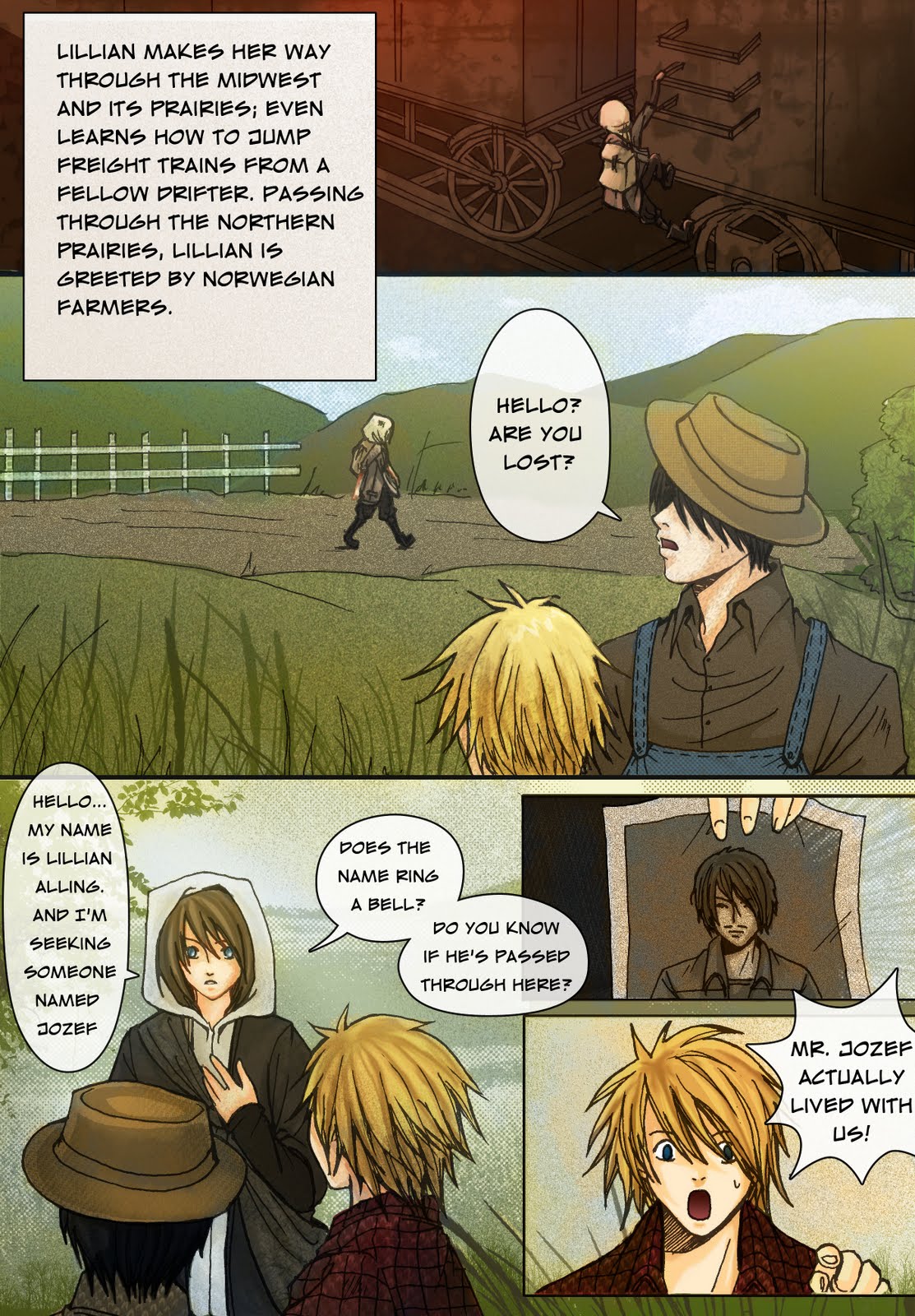
Lillian Alling, which is based on a true story, the central character is also in pursuit of a man, who she must find, for, as she puts it, “my life is bound to his life.” Like Inge, Lillian finds her destiny through surmounting what seem to be at times impossible obstacles. Lillian treks from New York City through Minnesota and eventually through British Columbia on her way to Alaska in her pursuit of a man with whom only an encounter will permit her to become the person she is determined to be.
Lillian’s walking song leave no doubt about her strength of will and the intensity of her search, and likely that of many of us at some point in our lives:
I open my eyes.
I pick up my pack.
I pick out a path.
I never look back.
The answers I lack
Lie further ahead.
I never, I never look back.
Both Inge and Lillian are forced at some points to adapt to circumstances they had not planned on encountering. They have to decide what to hold on to and of what to let go, just as we each do in our lives.
NATURAL WORLD AS FUNDAMENTAL TO OUR DESTINY. The two stories also run parallel in a way we sometimes forgot -- perhaps less so in Vancouver than in many others places in the world -- which is the ways the natural world around us is a fundamental part of the destiny we seek for ourselves. Thus we have the elderly Irene at the beginning of
Lillian Alling reminiscing about the beauty of northern British Columbia. Any of us who have lived there or travelled to the north will, I expect, share in what she feels:
The clean cold air
Falling like light through the trees
The winters
When even indoor breath can be seen
The summers
That give new meaning to what we mean by “green.”
Sweet Land similarly draws on the natural world for its authority. As a low-budget independent production,
Sweet Land is unequalled for its use of the natural world as its setting. Minnesota farmland across the seasons is front and centre. The amber tones of harvest are particularly striking, so much so they make dialogue gratuitous. Overall, Sweet Land depends more on visuals, principally of the natural world, for its power than it does on words.
METRO VANCOUVER CONNECTIONS. The fourth parallel I want to highlight is the Vancouver connection.
Sweet Land, released in 2005, was financially supported and co-produced by the actor Gil Bellows, who was born and bred in Vancouver and is known, as well as for numerous movies, for his television roles as
Ally McBeal’s love interest and as CIA agent Matt Callan in
The Agency. While based in Los Angeles, Bellows maintains an ongoing connection with Vancouver and with the Gulf Islands.
Lillian Alling has a multiple Vancouver and also British Columbian and Canadian connection. The Vancouver Opera production opening on October 16 and running to October 23 is the world premier of a consummately Canadian production with a Canadian composer and Canadian librettist. Not only that, much of the action occurs in British Columbia.
The Vancouver region comes to prominence in two important ways. The first is by virtue of Lillian, as pointed out in the promotion for the opera, being “incarcerated in Oakalla Prison Farm near Vancouver.” While this was in the early 1920s, Oakalla, which opened in 1912 only closed in 1991. The site is now condominium development overlooking Deer Lake in Burnaby. The large park like area around Deer Lake includes the Burnaby Art Gallery, Shadbolt Centre for the Arts, and Burnaby Village Museum with its excellent demonstration of live blacksmithing, so I urge you the next time you are there to reflect on
Lillian Alling’s incarceration.
The second way in which
Lillian Alling links into Vancouver is to the city itself. The librettist has Vancouverites alternatively lamenting and rhapsodizing, and I quote:
We have had the rain and the Lord be praised!
But now it is time for a drop of sun,
A week of sunlight,
Two days,
Or even one!
When the sun shines here,
It is like the first day of Creation.
The green reaches up, the green stretches out!
When the sun shines here,
Smell the earth’s fragrant exaltation,
And recall what the Garden of Eden is all about!
Partially in response, Lillian engages in a typical Vancouver activity, so she says:
On Sunday I will go to the Stanley Park,
To look at the water and the trees.
MY OWN LINKAGEI would like to think we will each see something of ourselves in these diverse aspects of
Sweet Land and
Lillian Alling. Let me close on a personal note as to how the movie and the opera resonate for me.
Much like the hero in
Sweet Land, my father emigrated from Scandinavia – in his case Sweden rather than Norway – to Minnesota to farm. I grew up in a Minnesota farm house that still stands, and is an almost exact replica of the
Sweet Land farmhouse, down to the outdoor clothesline with drying garments always seeming to be flapping on the wind and a prairie view that stretched as far as the eye could see. I used to think that the view went as far as the earth’s curvature, and perhaps it did.
While occurring later in time, I found many echoes of my upbringing in
Sweet Land. I grew up drinking bland coffee, and like the pastor in the movie got so used to it I recoiled whenever someone, as does Inge to the pastor, offered me what he disparages as “black coffee.” The Lutheran Church I attended as a child was equally set in its ways to the one in Sweet Land, but – all the same – I got goose bumps when I heard in the movie the congregation lustily singing “A Mighty Fortress is Our God.” Wherever our quest to find ourselves takes us in our lives, some things we never forget.
In the opera
Lillian Alling the protagonists treks from Russia to British Columbia very much as I did on seeking my destiny. For me this meant in the first instance escaping from the Minnesota evoked in
Sweet Land.
I began what I thought would be my career by doing a graduate degree at Harvard in Russian Studies and then writing for a London-based journal analyzing Soviet foreign policy. I can’t tell you the sense of nostalgia I felt on reading the opera’s libretto with its Russian phrases that is for me about the only remnant of my first career. “Boje moi,” my God! – I had not thought about the phrase in years and look forward to hearing it in the opera.
For various reason, my life took a turn, and this first career I surrendered to changing circumstances And so I made my trek similar to Lillian’s from Russia to British Columbia, and refashioned myself as a historian of the very same place where Lillian finds her destiny in the opera.
CONCLUSION Most of you will likely not see yourselves quite so literally as I did in both
Sweet Land and
Lillian Alling, but hopefully you will also be reflected in the search for self in which we all participate by virtue of being human. It is through reducing everyday life to its essentials that the movie and the opera permit us to share in a fundamental component of what it is that makes us who we are. Inge Alltenburg and
Lillian Alling each take chances and make sacrifices in search of their destinies and, as Inge reminisces in old age in looking back over her actions and their consequences, there are “different kinds of happy.”
Sweet Land and
Lillian Alling give each of us an opportunity to consider the path we have taken – and continue to take -- in search of ourselves. One of the satisfying features of both the movie and the opera is that we not only share in the search for meaning but we also come to understand that, at some time in our lives, the quest ends with ourselves. As we share with these two young women their determination to reach their destiny, whatever may be the cost of doing so, we come to realize, as Lillian puts it at one point:
Your journey is yours,
My journey is mine."
~ Jean Barman, Department of Educational Studies, UBC